
How to Use the Database
The Motet Text Database is designed for researchers wishing to access diplomatic transcriptions of motet texts in a searchable, metadata-rich format. It allows for different levels of categorization - by the component parts of motets organized by voice type (upper voice, tenor) and subparts (refrains), as well as manuscript witness information.
Simultaneously, the Motet Text Database can serve as a starting point to undergraduates or interested general audiences who wish to discover more about the world of thirteenth-cetury motet texts. As the site grows, functionality that emphasizes discoverability and broader accessibility will be introduced.
Use the navigation tabs above to access specific kinds of items: in Motets and Voices, you can explore the complete motets present on the site, as well as their component voice parts (upper voices, tenors, and refrains). In "Explore," users can discover different themes that appear across motet texts. Click the "advanced search" option at the top of any page to perform Boolean search operations.
Anatomy of items
Each motet and motet part is an "item," with different pieces of associated metadata. This section outlines what to expect in these kinds of items. Below, you can find examples of items that are live on the site to see how they are navigable.
All voices (tenors and upper voices) include:
- a title, which normally corresponds to the incipit
- a vdW number (from the Integrated Directory of Organa, Clausulae, and Motets of the Thirteenth Century, by Hendrik van der Werf)
- a language (typically either Latin or French)
- a list of motets in which the voice appears.
- an "item set," which allows all items of the same type to be grouped together.
Tenor items include
- information about the associated liturgical Feast (if applicable)
- the liturgical origin text
- a Cantus ID (when possible). These Cantus IDs link to the Cantus Index, which provides individual identifiers for chants found in manuscripts. For further details, visit them at https://cantusindex.org/.
Check out the example "Balaam" below to see these details in action.
Motet upper voice items include
- diplomatic transcriptions of the motet voice text for each manuscript in which the voice is found
- refrains, if applicable, which link to separate refrain items
- manuscript sources, which link to separate manuscript items
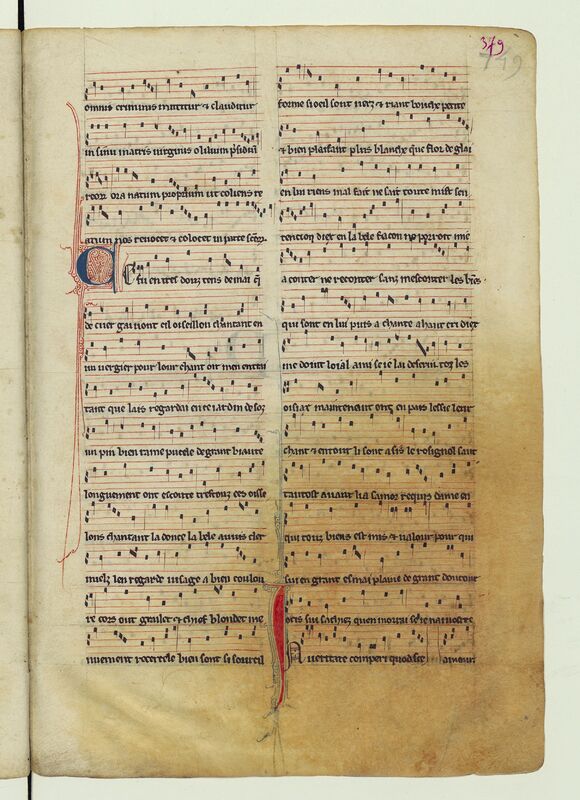
- media, where possible, which shows the specific folio of the manuscipt source(s)
Some upper voices may have "subjects" or "themes." These are part of an ongoing effort to offer wider discoverability of motet texts. As the site continues to expand, more subjects will be available.
Check out the example "Ce fu en tres douz tens" below to see these details in action.
Refrains have been expansively catalogued by Nico van den Boogaard in his Rondeaux et Refrains du XIIe siècle au début du XIVe. Each refrain has been assigned a van den Boogaard (vdB) number and, when applicable, is accompanied by the melody/text number assigned to motet voices by van der Werf (vdW). Refrains are also accompanied by a link to the Refrain Database, available at https://www.refrain.ac.uk/.
Click on the Item Set option (typically on the lefthand side of an item page) to see specific definitions of each metadata field.
- Title
- Ce fu en tres douz tens
- vdW number
- M 452a
- Description
- Motet upper voice found in one motet in Cl
- Language
- Old French
- Motet(s) in which voice appears
- In salvatoris nomine / Ce fu en tres douz tens / In veritate comperi / Veritatem
- Refrain(s)
- Diex me doint loial ami
- Manuscript Source(s)
- NAF 13521 ('La Clayette')
- Text
-
Cl:
[379ra] Ce fu en tres douz tens de mai q(ue)
de cuer gai vont cil oiseillon chantant en
un vergier pour lour chant oir men entrai
tant que lais regardai en ce iardin de soz
un pin bien rame pucele de grant biaute
longuement ont escoute trestouz ces oisse
lons chantant la douce la bele au vis cler
mielz len regarde uisage a bien coulou
re cors ont grailer (et) chief blondet me
nuement recercele bien sont si sourcil
[379rb] forme si oeil sont verz (et) riant bouche petite
(et) bien plaisant plus blanche que flor de glai
en lui riens mal fait ne fait toute mist sen
tencion diex en la bele facon ne porroit mie
a conter ne reconter sanz mesconter les bie(n)s
qui sont en lui puis a chante ahaut cri diex
me doint loial ami se ie lai deservi. toz les
oisiax maintenant ont en pais lessie leur
chant (et) entour li sont asis le rosignol saut
tantost avant li a samor requis dame en
qui touz biens est mis (et) valour pour qui
sui en grant esmai plaine de grant doucour
ocis sui sachiez quen morrai se ie nai nostre
amour. - Subject
- Courtly love